Android TV Guide - Dish Network
Redesigned the Dish TV Guide for Android TV set top boxes with a focus on modernizing the experience while preserving long established user mental models. Simplified an over engineered grid, reduced cognitive load, and optimized navigation for remote based interaction. The redesign improved discoverability of favorites, recordings, and on demand content while respecting the needs of long tenured Dish customers.
Client
Dish Network
DELIVERABLES
Design System, UX Guidelines, Creative Direction, User-Research
Year
2023
Role
Senior Product Designer
Context & Problem
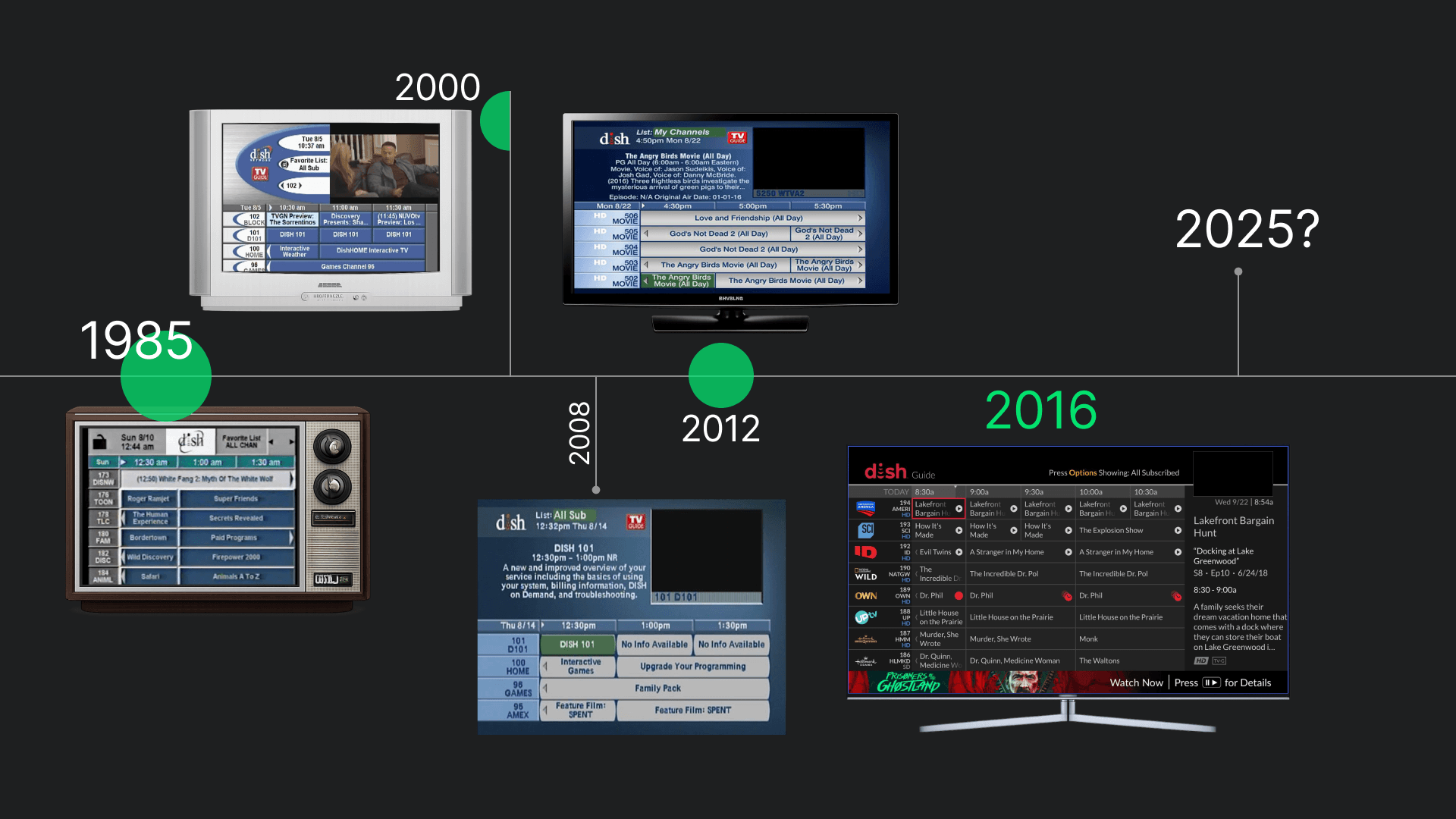
The Dish TV Guide has been redesigned multiple times over the past three decades to keep pace with evolving technology and shifting consumer expectations. Before initiating a new redesign, I intentionally looked backward, studying previous iterations and the rationale behind them, because many of the original decisions were made with care and any new solution needed to respect that legacy. This redesign was also scoped exclusively for Dish Android TV set top boxes, which introduced specific technical, performance, and interaction constraints that directly influenced design decisions.
Through this analysis, I discovered that the core fundamentals of the guide had remained largely unchanged, including horizontal navigation, two hour time blocks, on now versus future programming, and recording behaviors. Over time, however, the interface became increasingly dense. Additional states such as skipped, stopped, future recordings, series recordings, HD versus non HD channels, and repeating on demand channels were layered on through icons and indicators. These changes addressed surface level needs but never fundamentally evolved the information architecture. The result was an over engineered grid that was harder to parse, not easier to use.
Constraints & Understanding the User
I inherited this project after a previous designer left the company, with only a rough outline in place. At the time, I had limited experience designing TV interfaces and little familiarity with cable television systems, which made it critical to deeply understand both the medium and the users.
At first glance, the guide could be mistaken for a simple grid with a focus state, similar to a spreadsheet. However, this interface had to be optimized for a remote control, not a mouse, and for lean back viewing rather than precision interaction. Another key constraint was user tenure. Dish customers were not new adopters. Many had been using the service for eight to ten years or more. This meant that disrupting established mental models, including navigation patterns, focus behavior, or core workflows, would be a non starter for this redesign.
The challenge, therefore, was not reinvention, but evolution. The goal was to reduce cognitive load while preserving familiarity.
Design Approach & Key Decisions
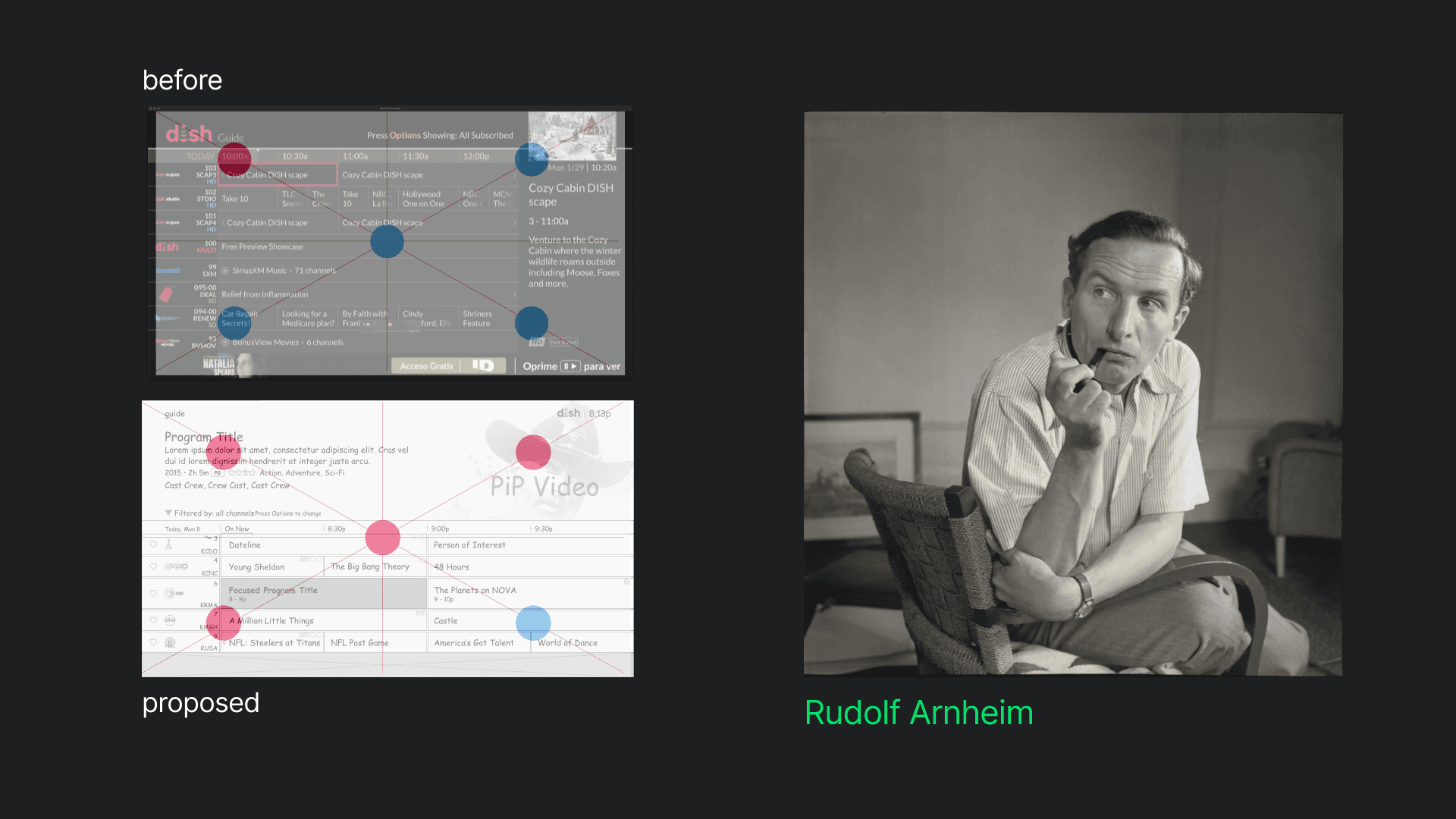
The final design was grounded in an Arnheim inspired structural layout, which emphasizes multiple visual focus points rather than a single dominant one. Previous iterations had leaned heavily on a single all powerful focus area which could be moved to the top or bottom of the guide. In contrast, the new layout paid homage to the past while modernizing its execution.
I introduced a five row grid where the focus area was intentionally no larger than the surrounding rows. Additional space was allocated to the show timeframe instead. This allowed the on now section to feel more present and continuous, especially important for group viewing scenarios where users want to check upcoming programs without losing track of what is currently playing, such as during live sports.
Focus placement was another critical decision. Through testing, it became clear that positioning the focus at the top or bottom of the grid limited visibility and context. Many users wanted to quickly scan what was airing above and below their current selection. Placing the focus state naturally in the middle of the grid proved to be the most intuitive and comfortable solution.

Features, Outcomes & Impact
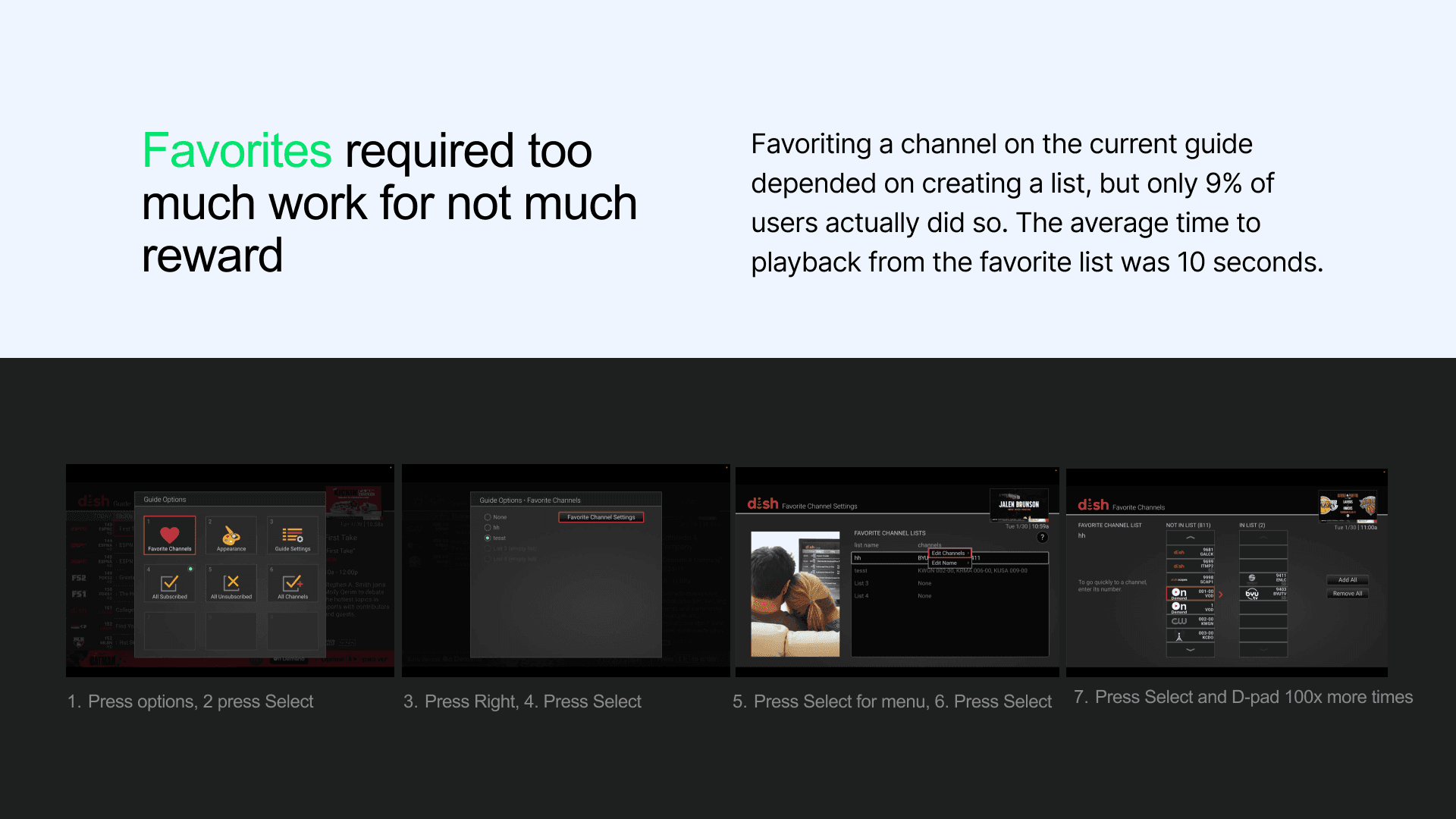
Favorites emerged as a high value but underutilized feature. Users navigated favorites in three distinct ways. Memorization, writing channel lists on paper, or manually curating favorites through a settings menu. The friction was too high for the perceived reward. In response, I moved Favorites out of settings and placed them front and center in the guide, paired with an immediate filter. This change dramatically reduced effort and increased engagement.
Bringing filters to the forefront transformed guide navigation. Instead of being buried in menus, filters became a primary interaction, making exploration intuitive and fast. Users consistently described the experience as effortless while testing interactive prototypes.
Recording was another core workflow. I redesigned the entire recording flow, simplifying the language and ensuring all recording actions could be completed within a maximum of two remote clicks. This aligned with patterns users were already deeply familiar with and avoided breaking trust through unnecessary change.
Finally, to boost on demand discovery and modernize the experience, I replaced repeating on demand channels with a dedicated visual shelf featuring video posters. This single addition dramatically improved content visibility, aligned the guide with contemporary streaming paradigms, and was overwhelmingly well received in testing.
The before and after comparison clearly illustrates how the guide evolved from a dense, over engineered grid into a streamlined, familiar, yet modern experience that respects long time users while meeting current expectations.
